


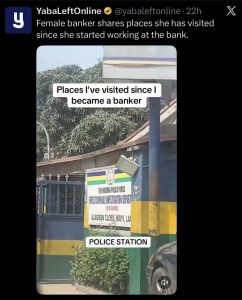
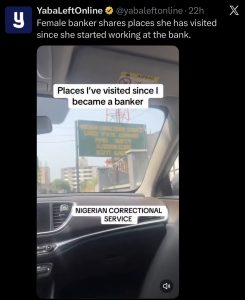
A viral video featuring a female banker has sparked conversations on social media after she shared places she had visited since she began working in the banking sector. The locations shown in the video include the Economic and Financial Crimes Commission (EFCC), a police station, the Nigerian Correctional Service and a high court.
The video, shared by YabaLeftOnline on X, has attracted reactions from social media users, with many joking about the experiences that can come with working in the banking industry. Others have questioned why a bank employee might need to visit several institutions associated with law enforcement and the administration of justice.
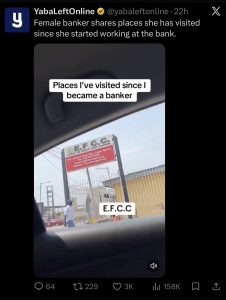
Although the video has generated humorous comments, it also presents an opportunity to discuss important issues that affect Nigerians, including financial responsibility, loan repayment, debt recovery, banking procedures and the role of law enforcement agencies.
It is important to note that the video does not establish why the woman visited these locations. A person’s presence at a police station, an anti-corruption agency or a court does not automatically mean that the person has committed an offence. Banking professionals may interact with public institutions for different legitimate reasons, depending on their duties and circumstances.
The discussion therefore goes beyond the identity of the woman or the humour surrounding the video. It raises a broader question about how people understand financial obligations and the legal processes that may arise when financial disagreements occur.
Read also: Bank Hacks & Inflation: Are You Getting Your Money’s Worth? Visit our website for more educational articles on finance and everyday life.
Credit Risk and Loan Recovery: Why Bankers Visit Police Stations and Courts
1. Why Banking Work Can Involve Law Enforcement Agencies and the Courts
Banking is an important part of the Nigerian economy. Banks provide payment services, savings accounts, business financing, personal loans and other financial products that help individuals and organisations manage their money.
However, banking work extends beyond receiving deposits and processing transfers. Depending on their roles, some banking professionals may deal with loan recovery, fraud prevention, compliance checks, disputed transactions, investigations and requests for financial records.
These responsibilities can sometimes bring banks into contact with law enforcement agencies and the courts.
One of the institutions featured in the viral video is the Economic and Financial Crimes Commission, commonly known as the EFCC. The commission investigates economic and financial crimes within its legal mandate. Matters involving suspected financial fraud, money laundering and other financial offences may require information or cooperation from financial institutions.
Banks also have internal compliance departments responsible for identifying suspicious activities, following applicable regulations and protecting customers’ funds. Where a transaction raises concerns, the bank may review the matter and respond to lawful requests from relevant authorities.
Another location shown in the video is a police station. The Nigeria Police Force investigates alleged criminal offences, maintains public order and performs other duties established by law. Banking professionals may interact with the police when reporting suspected fraud, providing relevant information, responding to inquiries or assisting with investigations.
Read also: 4 Years of Sapa How HAMZZY and His Siblings Stole the Internet with One Viral Post
The Nigerian Correctional Service performs a different function. It manages correctional facilities and carries out custodial and non-custodial responsibilities under the law. A visit to a correctional facility does not, by itself, reveal whether a person is an employee, visitor, official or someone involved in a particular case.
The high court shown in the video is also important to understanding the discussion. Courts hear cases within their jurisdiction, consider evidence, interpret the law and determine disputes brought before them. Financial institutions may become involved in court proceedings when a dispute concerns a loan, a contractual obligation, alleged fraud or another financial matter.
These institutions have different responsibilities. The EFCC investigates specified financial crimes, the police investigate alleged offences within their mandate, the correctional service manages correctional matters, and courts adjudicate cases brought before them.
Their roles should not be confused.
For example, an investigation is not the same as a conviction. An allegation does not establish guilt, and a person who visits a court is not necessarily a defendant in a criminal case.
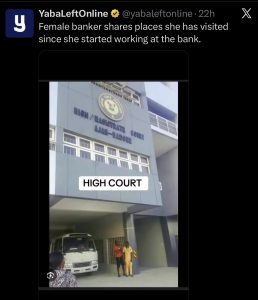
The viral video has not established the purpose of the woman’s visits, so it would be inaccurate to conclude that she was involved in a particular investigation or that the visits were connected to debt recovery.
Nevertheless, the video has drawn attention to the relationship between banking and the justice system. It also reminds the public that financial institutions operate within a wider legal and regulatory environment.
Understanding this relationship can help customers and employees distinguish ordinary banking procedures from matters that require formal investigation or judicial intervention.
2. Loans, Debt Recovery and the Importance of Financial Responsibility
One of the major discussions surrounding the video concerns loans and debt recovery. Some social media users have speculated that the locations might be connected to loan-related work, but the video does not confirm this explanation.
Even so, debt management is an important financial education topic because borrowing affects individuals, families, businesses and financial institutions.
A loan allows someone to access money with an agreement to repay it according to specified terms. People may borrow to support a business, pay for education, meet an emergency expense or purchase an asset. Businesses may also borrow to finance equipment, expand operations or manage temporary cash-flow difficulties.
Borrowing is not automatically a bad financial decision. The important questions are whether the loan is suitable for the borrower’s circumstances, whether the repayment terms are understood and whether the borrower has a realistic plan to meet the obligation.
Before accepting a loan, a borrower should read the agreement carefully. Important details include the principal amount, interest rate, repayment schedule, applicable fees, late-payment consequences and any collateral requirements.
A person should also consider whether the proposed repayments are affordable after accounting for essential expenses such as food, housing, transportation, education and other commitments.
For example, someone who earns a monthly salary may be offered a loan that appears affordable when considered in isolation. However, after rent, transport, household expenses and other obligations are deducted, the remaining income may not be enough to support the repayment schedule comfortably.
This is why financial planning matters before borrowing.
People should also be cautious about taking a new loan simply to repay an existing one. Although refinancing or restructuring may be appropriate in some circumstances, repeatedly borrowing to cover previous debts can make a financial problem more difficult to manage.
When repayment becomes challenging, early communication with the lender may help. A borrower can explain the circumstances, request a statement of the outstanding balance and ask whether an available restructuring or repayment arrangement is possible. Any revised agreement should be documented and understood by both parties.
Why Financial institutions also have responsibilities.
They should communicate loan terms clearly, follow applicable regulations, maintain appropriate records and handle customers’ information lawfully. Borrowers should not be misled about the cost of credit or the consequences of default.
Debt recovery must also be distinguished from criminal investigation.
Failure to repay a loan is generally a contractual or civil matter, although the circumstances surrounding a particular transaction may raise separate legal questions. For example, allegations of fraud, forgery or deliberate deception require consideration of the relevant evidence and applicable law. Not every unpaid loan is evidence of a crime.
Similarly, a lender cannot simply assume that every borrower who defaults has acted dishonestly. Someone may experience job loss, a business setback, a medical emergency or another unexpected financial difficulty.
At the same time, borrowers should not assume that taking a loan removes their responsibility to repay it. Loan agreements create obligations, and lenders may pursue lawful remedies when borrowers fail to meet those obligations.
The appropriate response depends on the agreement, the facts and the law.
For Nigerians, the practical lesson is to borrow carefully, maintain records of repayments, communicate early when difficulties arise and seek qualified legal or financial advice when necessary.
People should keep receipts, transaction confirmations, loan statements and written communications with lenders. These records can help resolve misunderstandings and provide evidence if a dispute develops.
It is also wise to avoid signing documents that one does not understand or agreeing to repayment conditions under pressure without first seeking clarification.
Financial literacy is not simply about knowing how to save money. It also involves understanding contracts, managing risks, recognising financial scams and knowing when to seek assistance.
External source: YabaLeftOnline — Visit the entertainment and news platform for its social media coverage and other trending stories.
3. What Nigerians Should Understand About the Law, Investigations and Online Reactions
The final lesson from the viral video concerns how people interpret legal institutions and discuss individuals on social media.
In Nigeria, the police, the EFCC and the courts have distinct responsibilities. Understanding those responsibilities helps the public avoid drawing conclusions from incomplete information.
The EFCC investigates economic and financial crimes within its statutory mandate. The police investigate alleged offences and perform law-enforcement duties. Courts assess cases and make judicial decisions based on the law and evidence presented before them.
An investigation may begin when an agency receives information or a complaint. Investigators may gather documents, interview relevant people and examine transactions. Depending on the circumstances, a matter may lead to further action, be referred elsewhere or be closed without a prosecution.
Where a case proceeds to court, the parties have legal rights and the court must determine the issues according to the applicable legal process.
The distinction between an allegation and a proven offence is essential. A person should not be labelled a criminal simply because their name appears in a report, they have visited an agency or they have been mentioned in an online discussion.
The same principle applies to banking professionals. Employees may be asked to provide records, assist with compliance procedures or participate in legal proceedings because of their professional responsibilities. The nature of any particular visit must be established through reliable information rather than speculation.
This is especially important when a video becomes popular online. Short clips often provide limited context. Captions, jokes and comments may create interpretations that go beyond what the original footage actually shows.
- Social media users should therefore separate what is visible from what is assumed. In this case, the video shows locations associated with law enforcement and the justice system, but it does not establish why the woman visited them.

Sharing an unverified accusation can harm someone’s reputation and may create legal risks. Before publishing claims about a person’s conduct, it is important to verify the information, consult credible sources and avoid presenting speculation as fact.
A responsible discussion can still be entertaining. People can joke about the surprising nature of the locations without accusing the woman of wrongdoing or claiming knowledge of her private circumstances.
There is also a broader lesson for employers and workers. Financial institutions should ensure that employees understand relevant compliance procedures, record-keeping obligations, customer confidentiality and the appropriate channels for reporting suspected misconduct.
Customers, meanwhile, should know how to raise complaints through their banks and use the relevant regulatory or legal channels when an issue cannot be resolved. Where a matter involves possible criminal conduct, appropriate authorities can assess the information and determine what action is justified.
Anyone facing a genuine legal dispute should seek advice from a qualified legal practitioner rather than relying entirely on social media comments. People dealing with financial difficulties may also benefit from a reputable financial adviser or a credible consumer-protection resource.

Ultimately, the most useful response to a viral story is not necessarily to decide what happened to the person featured in it. It is to understand the wider issues the story brings into public discussion.
The video has prompted Nigerians to reflect on banking, financial obligations and encounters with government institutions. Whether the visits were related to professional assignments, personal matters or something else remains unconfirmed by the footage.
What can be learned is that financial responsibility, accurate information and respect for due process are important in everyday life.
People should understand their financial agreements, seek help when necessary, respect the legal process and avoid judging others without sufficient evidence.
Conclusion
The viral video of a female banker visiting the EFCC, a police station, the Nigerian Correctional Service and a high court has generated humour and questions across social media. Beyond the reactions, it provides an opportunity to educate the public about financial literacy, debt management, banking compliance and the roles of Nigeria’s justice institutions.
The key lesson is simple: manage money responsibly, understand your legal obligations and verify information before drawing conclusions about another person.
A viral video may start a conversation, but reliable facts and sound financial knowledge should guide the conclusions people draw from it.